
Understanding the Chakras
A Simple Explanation
When you first come across the chakras, the same question tends to come up pretty quickly: what actually are they, and do I need to believe in them for this to work? I think that's a fair question. To me, the chakras aren't a concept you have to believe in, they're more like a map that helps you tune into your body, your energy and your inner experience more consciously.
The word chakra comes from Sanskrit and means something like wheel or disc. In various spiritual and yogic traditions, chakras are described as energy centres in the body where life energy is said to concentrate and flow. According to the understanding that's common today, especially in modern yoga and energy work, there are seven main chakras. They run along an imagined line from the base of the spine to the crown of the head, and each is associated with its own theme, colour and area of the body.
One thing matters a lot to me here: when I connect areas of the body or possible symptoms to a chakra below, that's an energetic perspective from the chakra teachings, not a medical diagnosis. Neck tension or an uneasy feeling in your stomach can have all kinds of causes, and if something persists or feels severe, a medical check-up always comes first. The chakra teachings don't replace medical treatment, but they can open up an additional, compassionate way of looking at yourself.
I see the chakras as a way to become more aware of your body and your inner experience. Sometimes it's worth taking a closer look: where do I feel free and connected right now? Where am I holding on? And which theme might want a little more attention at the moment?
The Meaning of the 7 Chakras at a Glance
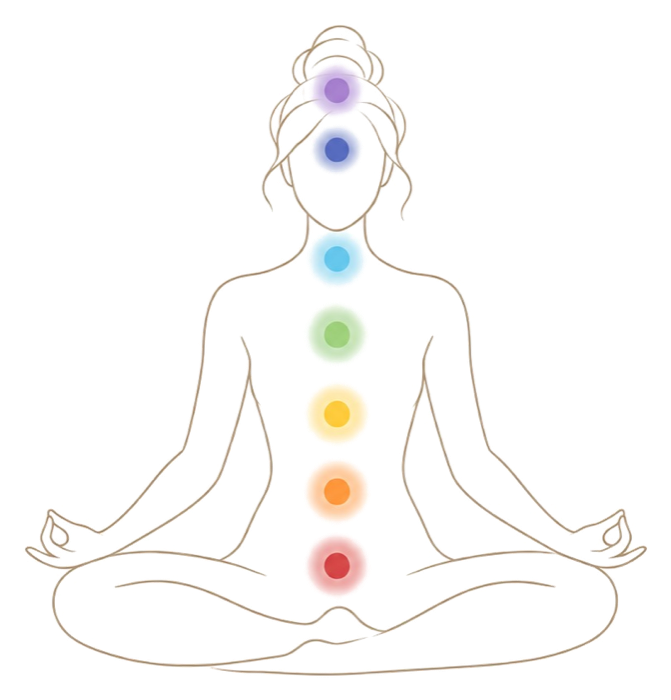
Before I go into each chakra in detail, here's a quick overview to help you find your bearings: the root chakra at the base of the spine, the sacral chakra in the lower belly, the solar plexus chakra in the upper abdomen, the heart chakra at the centre of the chest, the throat chakra at the neck, the third eye chakra between the eyebrows, and the crown chakra at the top of the head. Together, they form a kind of energetic line running through the whole body, from the ground up to the head.

1. Root Chakra
Sanskrit: Muladhara
Colour: Red
Location: base of the spine, around the pelvic floor
Themes: security, basic trust, stability, grounding, belonging, being rooted
Physical association: feet, legs, pelvic floor, lower back, large intestine, adrenal glands
The root chakra forms the foundation that all the other chakras build on. It's about the feeling of being safe and held, both within your own body and in the world around you. A stable root chakra often feels like solid ground beneath your feet, no matter what's going on around you.
When out of balance, the root chakra often shows up as:
- inner restlessness
- insecurity
- feelings of fear, unease or a lack of inner safety
- a feeling of having no solid ground beneath your feet
What's good for the root chakra:
- time in nature
- walking barefoot
- grounding exercises
- slow, mindful movement
- grounded movement, such as walking or slow strength-based movement

2. Sacral Chakra
Sanskrit: Svadhisthana
Colour: Orange
Location: lower belly, roughly a hand's width below the navel
Themes: emotions, creativity, joy of life, sensuality, sexuality, pleasure, relationships, aliveness
Physical association: lower belly, pelvis, reproductive organs, bladder, kidneys
The sacral chakra stands for everything that flows: emotions, creativity and the joy of life itself. It invites you to feel yourself and others without closing off, and to consciously allow yourself pleasure and sensuality.
When out of balance, the sacral chakra often shows up as:
- emotional withdrawal
- a lack of joy in life
- creative blocks
- difficulty with closeness and intimacy
- reduced sexual desire
- or, on the other end of the spectrum, overwhelming emotions that feel hard to manage
What's good for the sacral chakra:
- dancing
- creative activities
- flowing movement
- water in any form
- conscious enjoyment, without any guilt attached

3. Solar Plexus Chakra
Sanskrit: Manipura
Colour: Yellow
Location: upper abdomen, between the navel and breastbone
Themes: self-worth, self-confidence, ego, self-image, willpower, personal strength, boundaries, decisiveness
Physical association: stomach, digestive system, liver, gallbladder, pancreas
The solar plexus chakra is closely linked to our ego and self-image. I think it's worth saying clearly here that having an ego is something entirely natural and valuable. A healthy ego helps us know who we are, stand up for our needs, make decisions and follow our own path. This is, in a sense, where our inner "I can" and "I will" live. It's about self-confidence and willpower, about feeling your own strength without needing to put yourself above anyone else.
An imbalance here can show up in two very different ways, both belonging to the same underlying theme, just with opposite signs:
When out of balance, the solar plexus chakra often shows up as:
- self-doubt, over-adapting to others, difficulty setting boundaries
- or, on the other end of the spectrum, a strong need for control, dominance, a strong need for validation, or constantly feeling you have to prove yourself
What's good for the solar plexus chakra:
- consciously set boundaries
- movement
- warmth and sunlight
- activities where you can feel your own strength directly

4. Heart Chakra
Sanskrit: Anahata
Colour: Green, sometimes also pink
Location: centre of the chest
Themes: love, self-love, compassion, connection, forgiveness, closeness
Physical association: heart, chest, lungs, upper back, arms, hands
The heart chakra sits right between the three lower and three upper chakras, which is why it's often seen as the connecting centre, a kind of bridge between our earthly and our spiritual sides. It's about love in its broadest sense, self-love as much as compassion and genuine connection with others.
When out of balance, the heart chakra often shows up as:
- emotional withdrawal
- difficulty with closeness
- holding on tightly
- a lack of self-love
- unprocessed emotional hurt
What's good for the heart chakra:
- self-care
- gratitude
- time in nature
- loving touch
- consciously allowing feelings, even the uncomfortable ones

5. Throat Chakra
Sanskrit: Vishuddha
Colour: Light blue or turquoise
Location: throat and neck area
Themes: communication, truth, self-expression, finding your voice, speaking your needs, communicating boundaries
Physical association: throat, neck, thyroid, mouth, jaw, neck muscles, ears
The throat chakra is the centre of your own voice, both literally and figuratively. It's about saying what's really going on inside you, naming your needs and communicating boundaries clearly, rather than just feeling them internally and keeping them to yourself.
Within the chakra teachings, this centre is associated with certain energetic patterns, offered here explicitly as a traditional perspective, not a medical explanation:
When out of balance, the throat chakra often shows up as:
- frequent sore throats
- recurring tonsillitis or throat infections
- noticeably frequent throat clearing
- a lump in the throat feeling
- a husky voice
- neck and jaw tension, including teeth grinding
What's good for the throat chakra:
- singing loudly
- speaking honestly
- writing
- giving yourself space to express what you really think and feel

6. Third Eye Chakra
Sanskrit: Ajna
Colour: Indigo, a deep blue
Location: between the eyebrows, also known as the third eye
Themes: intuition, inner clarity, imagination, wisdom, connection to your own inner knowing
Physical association: eyes, forehead, head, nervous system
The third eye chakra is traditionally linked to intuition and inner clarity, the ability to see beyond what's purely visible and trust your own inner knowing. It's the chakra of the quiet voice inside you that often already knows what's right for you, before your mind has finished weighing things up.
When out of balance, the third eye chakra often shows up as:
- difficulty concentrating
- a sense of sensory overload
- constant overthinking
- difficulty trusting your own intuition
What's good for the third eye chakra:
- stillness and meditation
- conscious breaks from screens
- time and space for your own thoughts, for example through writing
- walking without distraction

7. Crown Chakra
Sanskrit: Sahasrara
Colour: Violet or white
Location: crown, the very top of the head
Themes: spiritual connection, connection to something greater, inner awareness, inner peace, meaning
Physical association: scalp, brain, central nervous system (energetic association)
The crown chakra completes the chakra line and stands for a connection to something greater than ourselves, however you understand that for yourself. It's about a sense of meaning, inner peace and connection that reaches beyond everyday life.
When out of balance, the crown chakra often shows up as:
- a sense of disconnection or meaninglessness
- restlessness
- difficulty settling into stillness at all
What's good for the crown chakra:
- stillness and meditation
- time in nature
- conscious moments of gratitude
- small rituals that bring you personal calm
What You Can Do with This Knowledge
You don't need to keep all seven chakras in view at once, or try to work on everything at the same time. I find it far more interesting to ask: which of these themes speaks to me right now?
Maybe you notice you're craving more grounding and stability. Maybe it feels hard to voice your needs or set clear boundaries. Sometimes it's simply a particular part of the body, or a feeling, that keeps drawing your attention back to it. The chakras can be a lovely way to tune in more consciously and see yourself from a different perspective. Some people talk about healing their chakras or releasing a blockage, and that's really what this is about for me too: a chakra can feel balanced from an energetic point of view, or there might be areas where energy currently flows a little less freely. My aim isn't to go hunting for blockages. It's more that working with the chakras can help you notice more consciously where attention, connection or energetic support might do you good right now.
There are many different ways to approach your chakras. A chakra meditation can help guide your attention consciously through each energy centre. Movement, breathwork, nature, sound or small daily rituals can all be ways to reconnect more strongly with yourself, too.
If you're wondering what chakra balancing actually involves, it simply means bringing these seven energy centres consciously into focus during a chakra balancing treatment. I look at your energy system as a whole, and at whatever comes up most clearly during the treatment.
If you'd rather start on your own first, you'll also find a guided meditation through the seven chakras in my meditation guide. There, we work with the four elements too, connecting each energy centre to its own visualisation.
Curious to explore your chakras?
If you'd like to explore your energy system more deeply, I'm happy to support you with Reiki at your home in Berlin or through distance Reiki.
You're also welcome to follow me on Instagram, where I share more from time to time on energy work and wellbeing.